
Why Sithonia Has the Best Beaches in Halkidiki
People argue about which peninsula in Halkidiki wins on beaches. I’ve sailed these waters long enough to have a clear opinion: Sithonia. Not because it has the biggest resort strips or the most sunbeds for hire, but because it has kept more of its coastline rough and real. The middle finger of the three Halkidiki peninsulas runs south into the Aegean and manages to hold both a calm, sheltered western shore and a wilder, cliff-broken eastern one. That contrast is what makes it interesting.
The roads around Sithonia are improving, but the honest truth is that a significant number of the best beaches here are still difficult or impossible to reach by car. Some are down unmade tracks that will scrape the bottom of a rental car. Some have no road access at all. That’s exactly why we run boats.
This guide covers the beaches worth knowing about, what makes each coast different, and how to use a boat day to see more than a week of driving would show you. I’ll be straight about what I know and what changes season to season.
West Coast vs East Coast: How the Two Sides Differ
The two coasts of Sithonia face different bodies of water and pick up different weather patterns. Understanding this before you go helps you choose the right day and the right beach.
The west coast faces the Toroneos Gulf. The water here is calmer, the sea floor in many spots is sandy and gradual, and the wind tends to arrive later in the day if it arrives at all. These are the beaches families lean toward: easier entry, warmer shallows, more shade from the pine forests that come almost to the waterline in places.
The east coast is a different story. It faces the open Singitic Gulf, takes more wind, and the scenery is sharper for it. Cliffs drop into the water, coves are tucked between headlands, and the sea colour shifts toward that deep blue-green you see in photographs and then doubt when you get there. The beaches are fewer and smaller, but the setting around them is more dramatic. Swimming conditions vary more day to day on this side.
Neither coast is better in absolute terms. It depends on what you want from the day.
The Beaches You Can Reach Only by Boat
This is the part most travel articles skip over or treat vaguely. Let me be specific about the category, even if the exact list shifts with the season.
Along both coasts of Sithonia there are coves that sit below cliff faces or behind rocky headlands with no path down from the road above. In some cases there was never a road to begin with. In others, the old track has eroded or been gated. From the water these places are obvious and accessible; from land they are effectively invisible.
What you typically find at these spots: fewer than a handful of other boats when you arrive, water that hasn’t been stirred up by beach crowds, and sometimes a small pebble or sand beach that looks like it was put there specifically for the purpose of dropping anchor and swimming. The snorkelling around the rocky edges of these coves is usually better than at the organised beaches, because the fish population hasn’t been scared off.
The trade-off is that there are no facilities. No taverna, no sunbeds, no freshwater shower. You bring everything you need on the boat. For some people that’s the whole point. For others it’s a dealbreaker, and that’s fine too.
Top West-Coast Beaches: Calm Water and Pine-Backed Sand
On the western side of Sithonia, a few beaches come up again and again when people ask me for recommendations.
Kalogria beach is one of the most talked-about on this coast, and the talk is justified. It’s a long arc of sand backed by pine trees that grow dense enough to provide real shade without any man-made structure. The water enters gently and the bottom stays sandy for a good distance out, which makes it genuinely comfortable for families or anyone who prefers not to pick their way across rocks to swim. It also has enough length that even on a busy day you can find a quieter section. By car it’s reachable but the road is rough in places. By boat you anchor off and swim in, which is frankly the better approach.
Livouri beach sits further down the coast and is less known than Kalogria, which is much of its appeal. The setting is similar, pine trees, clear water, sandy approach, but the crowd level is noticeably lower. It’s the kind of beach where you can have a reasonable stretch of sand to yourself even in August, which is saying something in Halkidiki in high summer. Access by road exists but is not easy. Most people who know Livouri well arrive from the water.
Elia beach is another west-coast favourite, known for shallow, warm water and the kind of flat sandy bottom that makes it ideal for children. It tends to have some facilities in season but retains a less developed feel than the busier resort beaches further north. The pine backdrop is consistent along this stretch of coast, and it gives the beaches a particular quality of light in the afternoon when the trees filter the sun.
Top East-Coast Beaches: Wild Cliffs and Crystal Coves
Cross to the eastern side of Sithonia and the character of the coastline changes sharply. The beaches are often smaller and reached after steeper descents, but the reward is scenery that is considerably more dramatic.
The water colour on the east coast is one of the things that surprises people who have only been to the western side. Because the seabed is rockier and the depth changes faster from the shore, you get those layered blues and greens close in to the rocks that look almost unreal. The clarity is also generally excellent on this side.
Several coves on the east coast sit below vertical or near-vertical cliff sections and are only reachable by water. These are the spots I mentioned earlier. Arriving by sailing yacht or catamaran and dropping anchor fifty metres from the cliff face, with nothing around you but rock and sea, is a very different experience from the organised beaches. The snorkelling along the base of those cliffs is excellent: sea urchins, octopus, and bream in particular are common.
There are also some beach spots on the east coast that have road access and some tourist infrastructure, particularly near the villages of Sarti and Sykia, but even these tend to feel less built-up than equivalent beaches on the Kassandra peninsula. The east coast of Sithonia has been slower to develop, and that shows.
Diaporos Island: The Offshore Crown of Sithonia
A short distance off the southern tip of Sithonia sits Diaporos, an uninhabited island with a coastline that rivals anything on the peninsulas themselves. The beaches here are reachable only by boat, full stop. There is no permanent population, no road, and no tourist infrastructure. What there is: shallow lagoon-like bays where the water is flat and extraordinarily clear, sand beaches that stay quiet because getting to them requires a boat, and a sense of space that’s hard to find in August anywhere else in northern Greece.
The most famous anchorage on Diaporos is the lagoon bay on the western side, where the water is shallow enough to see the bottom clearly from the boat and calm enough that you can paddle a board or a kayak in comfort. This spot appears in probably half the professional photographs taken of Halkidiki. Seeing it from a boat rather than a photograph is the version worth having.
Because Diaporos has no facilities at all, visiting it properly means carrying everything for the day on board. Our catamaran and sailing yacht are both equipped to handle a full day in an anchorage like this, but check the booking page for current details on what is included and what to expect on each cruise.
What to Look For in a Sithonia Beach (Crowds, Shade, Snorkelling)
When people ask me which beach is best, I always ask them back: best for what? The answer changes depending on the person and the day. Here is how I’d break it down.
For shade: The west coast pine-backed beaches are your best option. Kalogria and Livouri both have natural tree cover that you won’t find on the rockier east coast spots. If you burn easily or travel with young children, this matters more than the view.
For swimming comfort: Sandy-bottomed west coast beaches are easier to enter and exit. Rocky or mixed-bottom beaches, which are common on the east coast, are better for snorkelling but harder for swimming if you’re not wearing water shoes.
For snorkelling: Rocky coves win, and the best snorkelling is usually at beaches that are harder to reach, because fish populations are higher where there’s less foot traffic. The unmanned coves accessible only by boat tend to have the best underwater life. Diaporos is particularly strong for this.
For avoiding crowds: Any beach reachable only by water will be quieter than its road-accessible equivalent. This is true even in peak July and August. The difference in crowd levels between a popular organised beach and a boat-only cove on the same afternoon can be striking.
How to See the Most Beaches in One Day: Catamaran vs Sailing Yacht
We run two vessels and they suit different kinds of days.
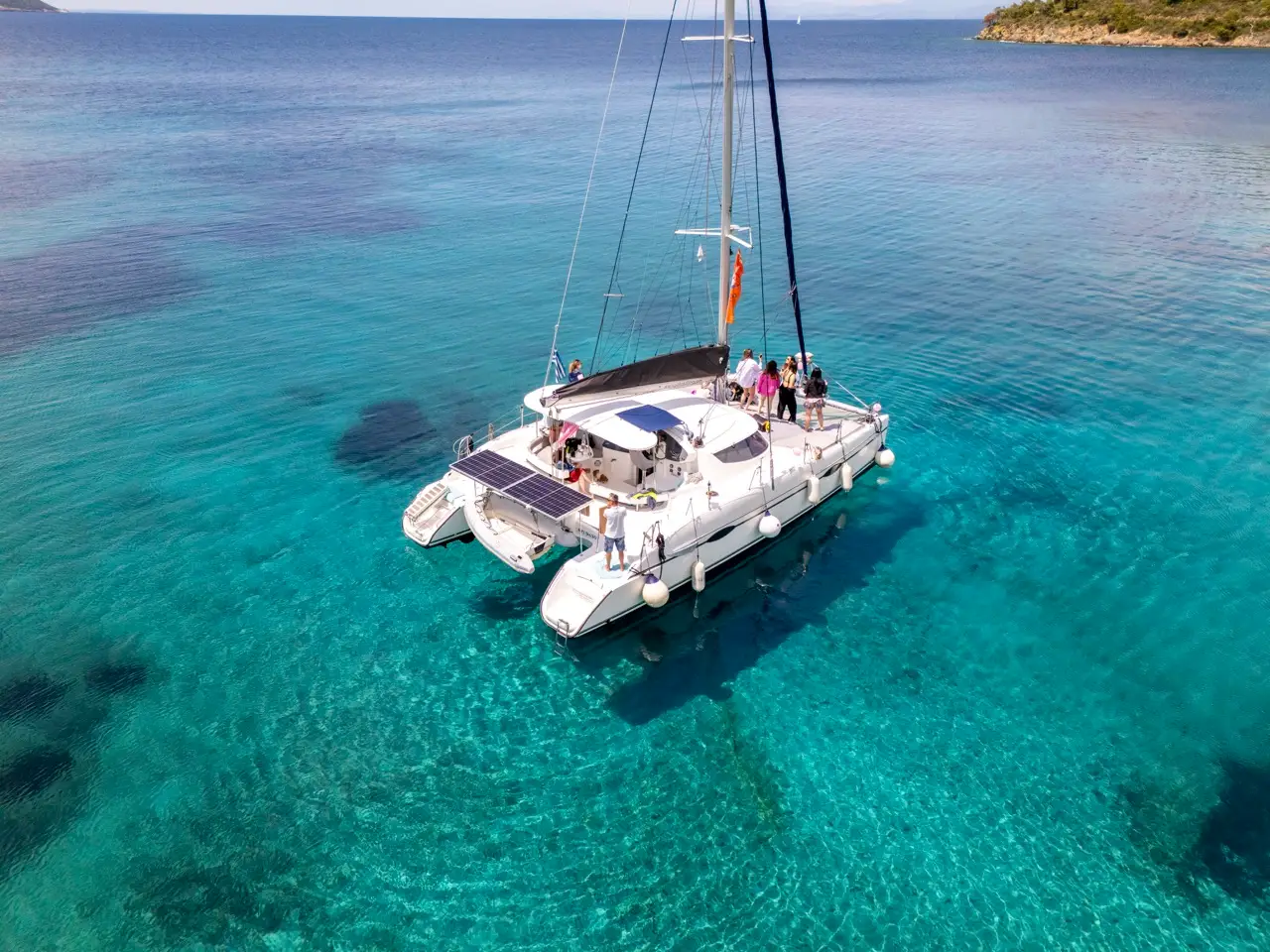
Our catamaran has a wide, stable deck and is particularly good for groups who want to spread out, relax between swims, and use the boat as a base rather than just transport. The shallow draft means it can get closer to shore in certain anchorages, and the deck space is generous for drying off and moving around. If you want to cover multiple stops at a comfortable pace without feeling crowded on board, the catamaran is the natural choice. The Full Day Catamaran Cruise runs for about seven hours, which is enough time to hit three or four stops properly, including time in the water at each one.
Our sailing yacht suits people who want the actual sailing experience as part of the day: wind in the rigging, the boat heeled over, a different kind of motion through the water. The Full Day Sailing Cruise covers similar ground in similar time, but the experience on deck is more active. If conditions are right and the wind is up, sailing between coves on the east coast of Sithonia is genuinely one of the better ways to spend a day on this coastline.
For half-day options, both vessels offer about five-hour cruises. The Half Day Catamaran Cruise works well for people who want a solid beach experience without committing to a full day, or who have other plans for the afternoon. You’ll reach fewer spots but the core experience, anchoring off a quiet beach and swimming in clear water, is the same.
The honest difference between a full day and a half day isn’t just time: it’s the number of stops and how far from the busier areas you can get. The boat-only coves and Diaporos take longer to reach, so they’re better suited to the full-day format.
Practical Tips: Best Time to Visit, Water Conditions and What to Bring
When to go: June and September are the months most experienced visitors prefer. The water is warm enough for comfortable swimming, the beaches are noticeably less crowded than July and August, and the wind patterns are generally calmer. July and August are perfectly fine but the popular organised beaches in particular fill up. If you’re boat-based, this matters less, because you’re going where the crowds aren’t.
Wind: Sithonia gets the meltemi, the northern Aegean summer wind, in the afternoon during the hottest weeks. On the west coast this is usually mild and often welcome. On the east coast it can build the swell enough to make certain coves uncomfortable for swimming in the afternoon. Morning departures generally catch calmer conditions.
What to bring: Water shoes are useful for rocky beaches. Snorkelling gear is worth having even if you don’t think you’ll use it. High-factor sun protection, more than you think you need, because reflection off the water doubles your exposure. Check the booking page for what each specific cruise provides, as this changes.
Food and water: Check current inclusions on the booking page. Some options include food and drink on board; others don’t. Either way, if you have preferences about what you eat, it never hurts to bring something.
Which Cruise Covers Which Beaches
I can’t tell you which exact beaches appear on any given cruise day, because the route adapts to conditions, anchoring options, and what’s working on that specific morning. What I can tell you is the general logic.
The Full Day Catamaran Cruise and the Full Day Sailing Cruise, at about seven hours each, give enough range to reach the more remote coves and islands that shorter trips can’t fit. If Diaporos or the boat-only east coast coves are your priority, a full-day format is the right call.
The Half Day Catamaran Cruise, at about five hours, covers the beaches that are closer and still well away from the organised resort strips. You’ll swim in clear water at a quiet spot; you just won’t push as far south.
For specific current information on routes, departure points, prices, and group sizes, the booking page is the right place to look. These things change with the season and I don’t want to publish numbers here that are out of date by the time you read them.
Frequently Asked Questions
What are the best beaches in Sithonia?
It depends on what you want. For calm water and pine shade, the west coast beaches including Kalogria, Livouri, and Elia are consistently recommended. For dramatic scenery and clearer, deeper-looking water, the east coast coves are harder to beat. For complete quiet and the best snorkelling, the boat-only coves and the beaches around Diaporos island are in a different category entirely. The “best” beach in Sithonia for you is the one that matches your priorities for that day.
What is the #1 most beautiful beach in the world?
Every list is different and most are paid for by someone. What I can say is that the beaches around Sithonia and Diaporos consistently appear in serious rankings of the best beaches in Europe, and when you’re anchored off one of the quieter coves on a calm morning with the pine forest behind the sand and nobody else around, it’s genuinely difficult to think of where you’d rather be. I’ll leave it at that.
What are some of the most beautiful beaches in the Greek islands?
The Greek islands get most of the attention but the mainland coast, and specifically Halkidiki, competes directly with the best of them on water clarity and beach scenery. Sithonia has the added advantage of being accessible from Thessaloniki without a ferry crossing. The comparison with Lefkada, Milos, or Kefalonia is a fair one. The main difference is that Sithonia is less photographed, so your expectations are calibrated differently.
Which village in Halkidiki is considered the best?
Again, depends on what you’re after. Sarti on the east coast of Sithonia is popular with people who want a real village feel with a long beach right next to it. Nikiti on the west coast has a charming old upper village. Vourvourou on the east coast is the base most people use for reaching Diaporos. There isn’t a single answer, but if you’re coming primarily for beaches and boat trips, Sithonia villages in general will serve you better than the busier resort towns on Kassandra.


The summer slots fill fast, so the sooner you reach out, the better your options.
🎈 Special requests?
Decorations, catering, surprise arrangements, just ask.
Contact Us →